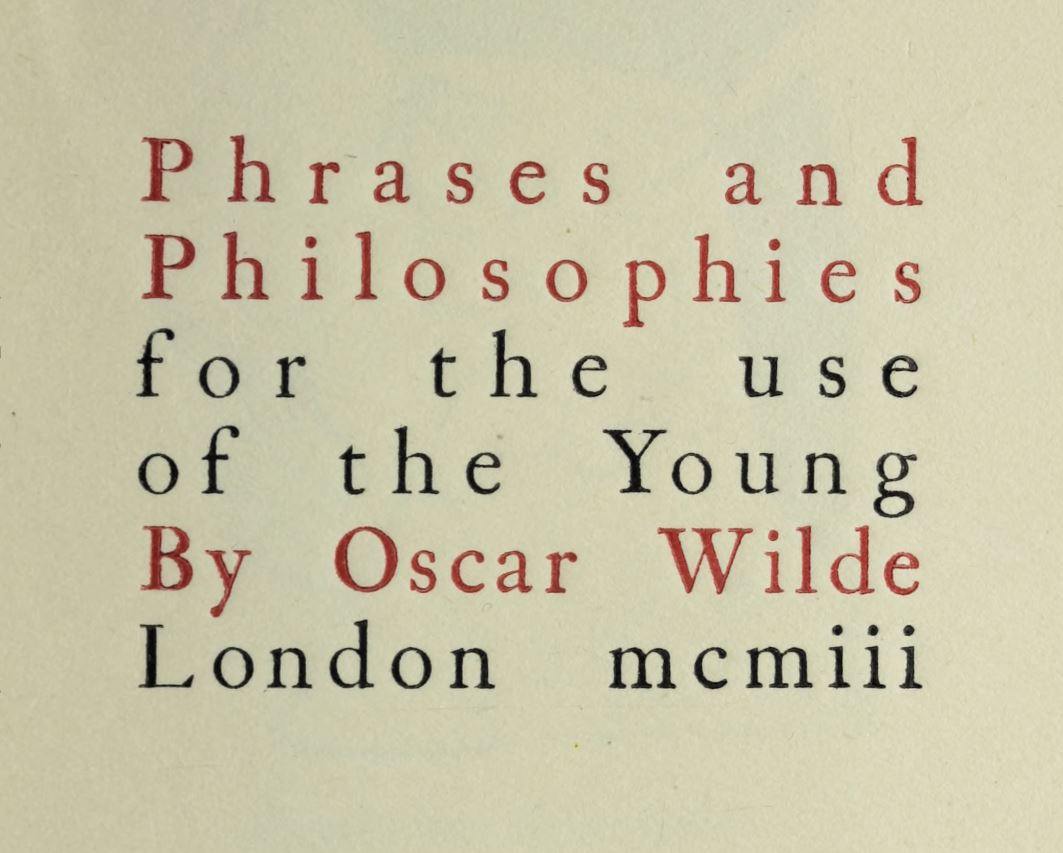
Among the pithiest works of an author infamous for pithiness, Oscar Wilde’s “Phrases and Philosophies for the Use of the Young” comprises a set of epigrams offering advice to the youth that, bless their foolish hearts, they will not accept without a years-long battle.
Most versions of this list easily found online are relatively barebones, making no attempt to provide explanations of such epigrams or words as may require them these days. I am no scholar, but I think adding a little context and speculation could help others encountering these aphorisms for the first time to give them more than a cursory read and chuckle.
As is often the case with Wilde, what appears merely glib or cynical at first often reveals itself to be more thoughtful when you reckon with his capacious intelligence and unique aesthetic — not to mention the historical context for the list. In a word: he contributed the piece to help launch a (very gay and edgy) student literary journal, The Chameleon, headed by a young lover of his. Though his piece was relatively innocent, its proximity to such obvious wickedness helped sink him in court later on charges of indecency.
These epigrams likely originated impromptu in the course of Wilde’s famed conversation, and were later lightly refined for publication; so it is worth keeping in mind he was not up late hunched over his desk composing these, but that he would have invented them on the fly for an audience and found the real meaning in discussion. That is why some of these give the sense that they are not self-contained but the beginnings, ends, or middles of conversations.
(One textual note: there are some variations of this list, with more or fewer entries or some variant phrasing. I reproduced the following from a simple, well-edited 1950 collection of his essays I bought in Dublin. Images from this version.)
The first duty in life is to be as artificial as possible. What the second duty is no one has as yet discovered.
This sounds like Wilde is lampooning how other people seem to think (i.e. with no real depth). But I think his definition of artificial is more nuanced. To be artificial, if we take this advice seriously, is to boldly invent a self and present that self to others. The advice is not to be superficial; it is to compose oneself as a masterpiece. What other duty can one have?
Wickedness is a myth invented by good people to account for the curious attractiveness of others.
It’s tempting to say Wilde is honest in his appraisal as the inventors of wickedness as “good.” There is an argument to be made for his giving others some grace in finding a way to acknowledge attraction outside our control as existing within a moral system. But ultimately I think the cynical read is more correct: the “good” people are deluding themselves with a label that immediately tells on them.
If the poor only had profiles there would be no difficulty in solving the problem of poverty.
Wilde’s use of the word “profile” here, as would have been clear at the time, is not in the modern sense of journalistic profile or dossier, but that of facial (or bodily) contours. For him, physical beauty was an important virtue, and let us admit it is hardly a neglected one today. I think this little saying plays on the shallowness of those who, like himself, care more for beautiful people than others. Since the poor were so less likely to possess (or what is ultimately the same, cultivate) this beauty, they are more likely to be written off. (Incidentally, one biographer noted that his stint in prison left him somewhat more sympathetic to the unfortunate.)
Those who see any difference between soul and body have neither.
Far from being an endorsement of materialism, I think this is a warning against letting one’s life and opinions be defined or limited by ordinary metaphysics. Question the question, and the questioner.
A really well-made buttonhole is the only link between Art and Nature.
I see this quoted frequently, and I think it is an odd one. By buttonhole, Wilde does not mean the actual hole a button goes through, but a small flower arrangement that would be put in the top buttonhole of a suit jacket — a corsage, basically. So this tiny bouquet is the only place where Art and Nature overlap.
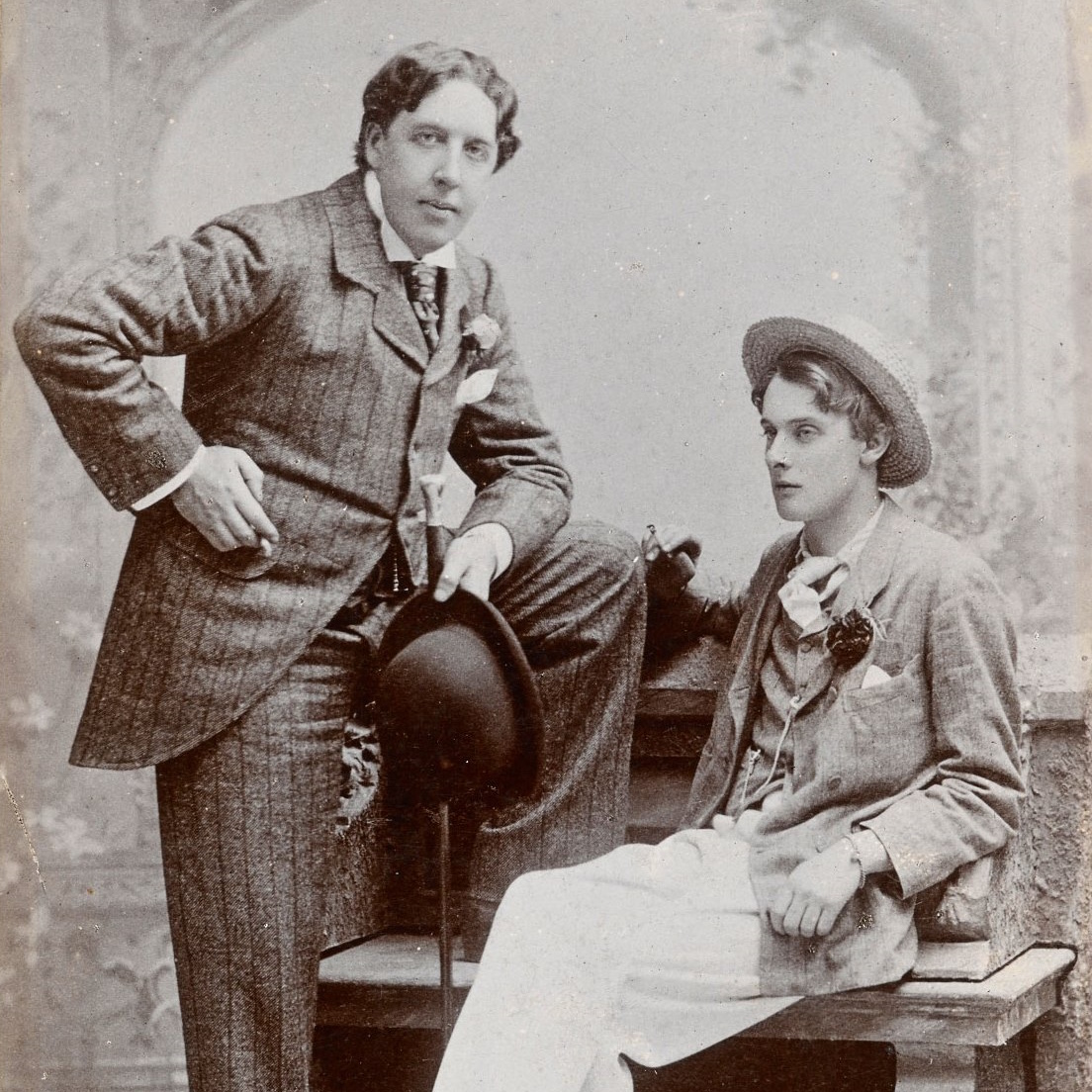
Now, he may well believe this as a simple bit of fun and foppery, and after all he often wore one.
But I think he is also (as always) playing with words. Art and Nature are capitalized and, of course, both have multiple meanings. Art as in artifice, and artificial, is his way of describing how a person creates and presents their identity (see first quote). Nature is what one is born with or raised within. That, however, only further muddies the waters. What was he really saying? I suspect this is one where you had to be there for the conversation to truly understand his perspective.
Religions die when they are proved to be true. Science is the record of dead religions.
This can be read as a summary of rationalist or Enlightenment views, and I think it is valid as such. But Wilde was a romanticist and, though he disdained religion, he also questioned the ultimate value of science. Calling it “the record of dead religions” is great, but he chose his words carefully and the effect is not one of elevation. If anything it denigrates science as a mere reliquary. The implication is that life and value lie somewhere else entirely.
The well-bred contradict other people. The wise contradict themselves.
Wilde said admiringly of London dinner parties that “the clever people never listen, and the stupid people never talk.” The well-bred (i.e. the gentry) speak with and from authority of an orderly universe and social order, correcting those of lesser status — not necessarily of lesser intellect. The wise, on the other hand, can hold the contradictions of identity and worldly paradox in mind comfortably and without needing to reconciling them, or other people to them. Note that he says wise and not clever; cleverness is the ability to analyze and arrange and express things, while wisdom is to understand their significance and, in this case, accept their seeming incompatibility.
Nothing that actually occurs is of the smallest importance.
On the surface, it may be seen as a terse commentary on the pettiness of all affairs, which sooner or later fade into nothingness. What seems of utmost importance to one may be trivial to another, and vice versa. But I don’t think Wilde was of the “we are but motes in the vastness history” type — that verges on metaphysics, which of course he wants nothing to do with.
What I think he was getting at here is something more in the vein of Camus: if nothing has inherent importance, it is up to us to decide what is important, and consequently how we want to live. I think Wilde’s take would be a little more on the romantic (i.e. Byronic) side, but the idea is similar. Nothing matters unless you want it to.
Dullness is the coming of age of seriousness.
Serious (derogatory) is, I think, a quality Wilde deplores in young people who have adopted a conventional mode. With the excuse of seriously pursuing something, they decline the frivolity and idleness which Wilde so treasured. This process continues until the person is defined, and dulled, by their most serious qualities because their mental vivacity has atrophied through disuse.
In all unimportant matters, style, not sincerity, is the essential. In all important matters, style, not sincerity, is the essential.
This one may actually just be glib. But Wilde is not merely saying “razz it up and everything will be fine.” It’s practical advice to do things with passion, because passion is the result of individualism. Sincerity is fine — but anyone can do sincerity, and one sincerity is much like another. One recalls The Prisoner of Zenda: “It makes your sin no worse, as I conceive, to do it a la mode.”
If one tells the truth, one is sure, sooner or later, to be found out.
Though on its face this is merely an inversion of the moralistic (and untrue) notion that a lie will always be caught out eventually, I think it is actually a very heartening sentiment he is expressing here. In keeping with his advocacy for passion, style, art, and beauty, he holds the truth — not mere factual truth but aesthetic and personal truth — in the highest regard. To be truthful, to express truth as one understands or interprets it, is a noble calling and it will, in time, attract those to whom this truth speaks. As one who made his fortune (and later lost it) by following his own advice, this has a personal, encouraging note.
Pleasure is the only thing one should live for. Nothing ages like happiness.
Though this is transparently a plea for hedonism, I suspect Wilde would advise the youths to pursue the more complex pleasures rather than the animal ones. Sex, booze, and food are all well and good, but it takes more than these to build a happiness worth holding (and aging into).
It is only by not paying one’s bills that one can hope to live in the memory of the commercial classes.
On the one hand, this reflects the ancient custom of gentlemen to live in enormous, crushing debt they can only pay by marrying a fortune. But it also points out the more subversive fact that merely participating in commerce marks you as, at best, commonplace to that class; to cultivate a healthy frenemy among merchants, be wily and defer payment indefinitely. A healthy disdain for money was fashionable at the time, I suspect, but less possible to get away with these days.
No crime is vulgar, but all vulgarity is crime. Vulgarity is the conduct of others.
One sense of this is that any crime can be performed for noble reasons — though opinions may differ on whether one is truly doing so.
The epigram can also be a twofold warning. Vulgarity is a crime, so one should endeavor not to be vulgar. But vulgarity is the conduct of others? So to me, your conduct is vulgar; to you, mine. Do not be so eager to dole out judgment on this front, and meanwhile do your best to avoid attracting the judgment of others on this front — for it may have merit.
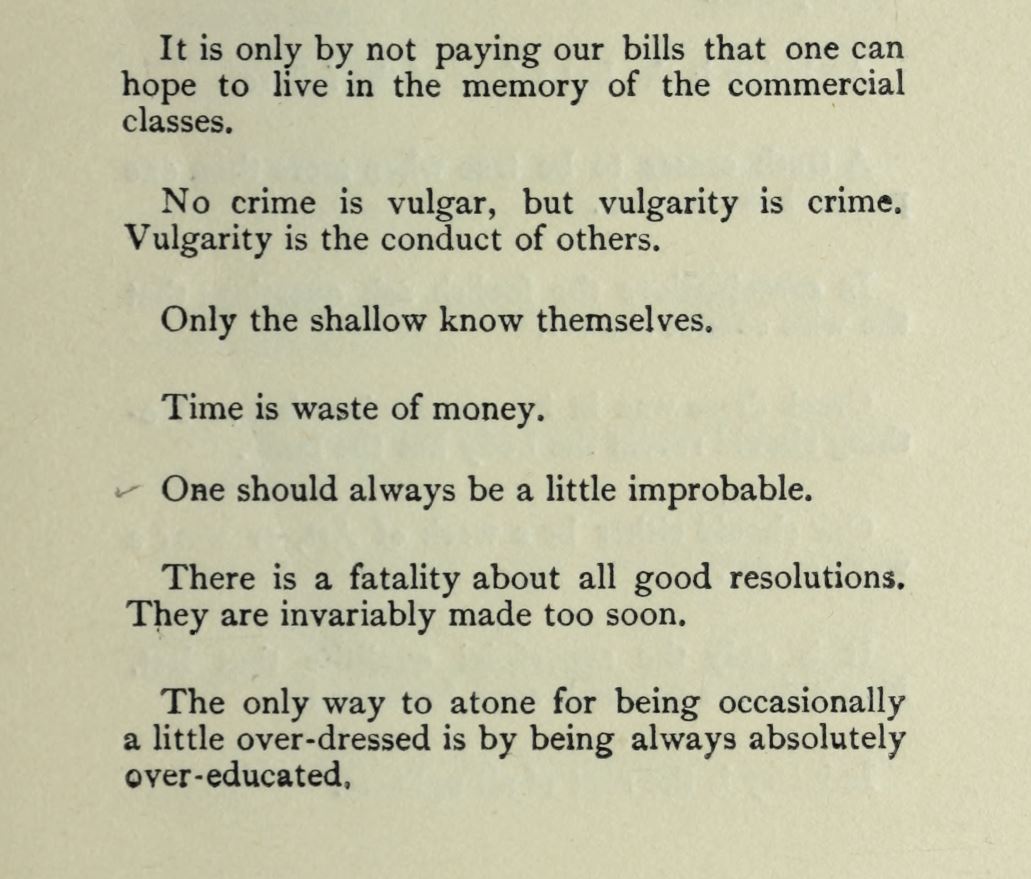
Only the shallow know themselves.
This only rhetorically contradicts the famous maxim of Socrates to “know thyself.” It is in keeping with Socrates and fair warning that the process of inquiry and self-examination is a lifelong one that may never conclude satisfactorily. For anyone to know themselves completely, either there must not be much to know, or they must not know how much more there is.
Time is a waste of money.
I file this one under glib throwaway, but the reader can probably find their own way to make it poignant.
One should always be a little improbable.
Put another way, you might say that you should never be entirely what other people expect, or even what is reasonable. Others should say of you, “he wouldn’t really… would he?” But one should only be a little improbable — take it too far and it becomes the probable, and therefore boring.
There is a fatality about all good resolutions. They are invariably made too soon.
It is commendable for someone to say, for instance, “I have a drinking problem” and cut back — I think even Wilde would agree there. But I feel his advice here is to live within one’s weaknesses for a while, rather than averting them entirely. The suggestion to “leave half an hour before the devil arrives” (not Wilde’s) works best if you know the devil personally and not just by reputation.
The only way to atone for being occasionally a little over-dressed is by being always absolutely over-educated.
It is unlikely Wilde would consider someone overdressed for an occasion; however, they may be overdressed for their person. Clothes are table stakes, and you have to live up to them with your intellect and conversation. Anyone can pay a tailor, but what’s inside the suit also counts.
To be premature is to be perfect.
My guess on this one is that Wilde is militating against the idea that one should wait until the “right time” to do or say something. The time to do it is whenever you feel like it. Anything else is catering to the expectations of others — which are, of course, unimportant.
Any preoccupation with ideas of what is right and wrong in conduct shows an arrested intellectual development.
As in some of the above sayings, Wilde warns against any infantile moralism like that which would, shortly after writing this, condemn him.
Ambition is the last refuge of the failure.
Wilde’s use of ambition here is derogatory — the type of “ambitious” we use when a colleague constantly says how they’re going to be the boss one day, while the actual future boss quietly outpaces them. There is not just that sense of “the empty drum sounds loudest,” though Wilde surely encountered plenty of empty drums in his life. It is also that ambition is a vulgar surrender to conventional expectations — setting one’s sights on the top of the dungheap.
A truth ceases to be true when more than one person believes in it.
Truth was, I suspect, both a universal and very personal notion for Wilde. And the type of truth he is referring to here is, again, not some factual truth but deeper truths about ourselves, culture, beauty, love. Such truths, if one is lucky enough to find them, are intensely individual, their roots deep within one’s own life, feelings, and thoughts. It’s impossible for my truth and your truth to be exactly the same because you and I are not exactly the same. To say then that we (and for that matter a million others) share a truth compromises, blurs, or dilutes that truth.
In examinations the foolish ask questions that the wise cannot answer.
I feel Wilde would have enjoyed the “Gateless Gate” of Mumon, and perhaps he did; more than a little of his advice is about questioning or un-asking the question. In this case he is pointing out the danger of a misguided or mistaken attitude of inquiry. Such inquiry may even have the appearance of expertise. This informs the more prosaic alternative interpretation (given the context of “in examinations,” i.e. by schoolmasters or other notional superiors) that academic testing is a charade.
Greek dress was in its essence inartistic. Nothing should reveal the body but the body.
This and the following advice are not to be taken as any form of slut-shaming. Far from it — Wilde is just sharing his belief that the human form has a very specific beauty that it is hopeless to attempt to improve. The Greeks loved the body too, but they tended (or so Wilde understood) to wear shapeless, practical garments; was that their aesthetic, or just the state of the art when it came to clothes back then? I suppose Wilde would opt for the former, while knowing it was actually the latter. “The wise contradict themselves,” after all.
One should either be a work of art, or wear a work of art.
Here we see Wilde’s philosophy in a nutshell: embody beauty, creation, and truth however you can. If that means being young and beautiful, great. At some point that is no longer an option, but one can still rock a buttonhole or drop a legendary epigram.
It is only the superficial qualities that last. Man’s deeper nature is soon found out.
Glib, but Wilde points out an uncomfortable truth that deep down we’re none of us particularly different. Just a bunch of humans walking around in a time and place not of our choosing, and I suspect Wilde had no high opinion of “Man’s deeper nature.” What we can control may be superficial, but it’s the only thing that matters.
Industry is the root of all ugliness.
Though it’s next to matters of appearance, this little epigram is not just saying if you work too hard you’ll get wrinkles. Wilde had a special form of disdain for hard workers; I suspect he felt that everyone should do what comes naturally, and those who battle against their nature through effort (industry) will damage their humanity.
The ages live in history through their anachronisms.
This and the following entry are of a kind: what we keep from olden days is not what is most familiar to us, but what is most unlike us. Yet in that unlikeness we find insight and an unrepeatable lesson. Ironic now given Wilde’s life and advice has in some ways passed into anachronism, when he was himself a great curator of anachronism; he would be pleased.
It is only the gods who taste of death. Apollo has passed away, but Hyacinth, whom men say he slew, lives on. Nero and Narcissus are always with us.
I suspect Wilde would have looked on the decline of the classics as a great tragedy. What he means here is that Apollo is no longer worshiped, but the names and stories that the gods and their contemporaries produced are still very relevant. The story of Narcissus drowning in his own reflection or Nero playing his lute while Rome burned (apocryphal, but evocative) stay with us more than some creation myth or Apollonian feat. One has become a mere children’s story, while the others wreathe foundations of civilization and thought. That or, given the flowers, this is another buttonhole reference.
The old believe everything: the middle-aged suspect everything: the young know everything.
This clever inversion of the path of wisdom becomes more true the longer you live (and the more you believe).
The condition of perfection is idleness: the aim of perfection is youth.
Perfection is not a process or action, but a state, and a resting state at that. One cannot work towards perfection, only be perfect. Youth and beauty and truth unite in Wilde’s mind as that perfection.
Only the great masters of style ever succeed in being obscure.
Perhaps a particular warning to the hyperliterate students who would likely be reading The Chameleon (or scribblers who would be reading the Saturday Morning Review, for which this list was originally intended), it is obvious to any serious reader that to write obscurely is the easiest thing in the world. To write things that only you understand, in a way that only shows itself to you, is essentially to journal. If that is valuable to you, bravo; it does not follow that it is so to others. A reader must have some faith that what lies behind the obscurity is an idea worth drawing out, and that is a mighty difficult thing to convince them of through prose alone.
There is something tragic about the enormous number of young men there are in England at the present moment who start life with perfect profiles, and end by adopting some useful profession.
Glib but hilarious. If only all the beautiful young people of this world could simply exist idly in perfection rather than hurrying the blush off the rose through industry and rectitude. Certainly that would be Wilde’s idea of paradise.
To love oneself is the beginning of a life-long romance.
A saying that bears no explanation.