
The Holy Mountain
The Holy Mountain
‘Tis one thing to copy, and another thing to imitate from nature. The copier is that servile imitator, to whom Horace gives no better name than that of animal; he will not so much as allow him to be a man. Raphael imitated nature; they who copy one of Raphael’s pieces, imitate but him, for his work is their original. They translate him, as I do Virgil; and fall as short of him, as I of Virgil. There is a kind of invention in the imitation of Raphael: for though the thing was in nature, yet the idea of it was his own. Ulysses travel’d, so did Aeneas; but neither of them were the first travelers: for Cain went into the land of Nod, before they were born: and neither of the poets ever heard of such a man. If Ulysses had been kill’d at Troy, yet Aeneas must have gone to sea, or he could never have arrived in Italy. But the designs of the two poets were as different as the courses of their heroes, one went home, and the other sought a home. To return to my first similitude. Suppose Apelles and Raphael had each of them painted a burning Troy; might not the modern painter have succeeded as well as the ancient, though neither of them had seen the town on fire? for the draughts of both were taken from the ideas which they had of nature. Cities had been burnt before either of them were in being.
Sister Crayon – “(In) Reverse”
Bellow
With shades of Nudge, but with more of a focus on the vocalist’s soft but soaring voice, Sister Crayon’s Bellow is a thoroughly pleasant album which, while it rarely ventures too far in any direction, succeeds very well at what it does. There are a few times when they transcend their own type – the brief ending revel of “Stem,” or the mechanical repetition of “Anti-Psalm,” but for the most part it’s just a beautiful place to inhabit for an hour or so. (insound)
The Internet Archive To Archive Itself On Paper
“Internet Archive is building a physical archive for the long term preservation of one copy of every book, record, and movie we are able to attract or acquire. Because we expect day-to-day access to these materials to occur through digital means, the our physical archive is designed for long-term preservation of materials with only occasional, collection-scale retrieval. Because of this, we can create optimized environments for physical preservation and organizational structures that facilitate appropriate access. A seed bank might be conceptually closest to what we have in mind: storing important objects in safe ways to be used for redundancy, authority, and in case of catastrophe.”
apothegm: a cryptic or pithy, yet instructive, remark or phrase
venditate: to announce or cry out, or to exhibit or blazon
cicisbeo: the escort or lover of a married woman
cark: to care or worry, or a care or worry
disembogue: to discharge or flow forth
badinage: playful banter or raillery
tontine: a type of shared annuit
emmet: archaic term for an ant
tetric: harsh, sour, or rough
halser: rope
There are surely other worlds than this: other thoughts than the thoughts of the multitude, other speculations than the speculations of the sophist. Who then shall call thy conduct into question? who blame thee for thy visionary hours, or denounce those occupations as a wasting away of life, which were but the overflowings of thine everlasting energies?
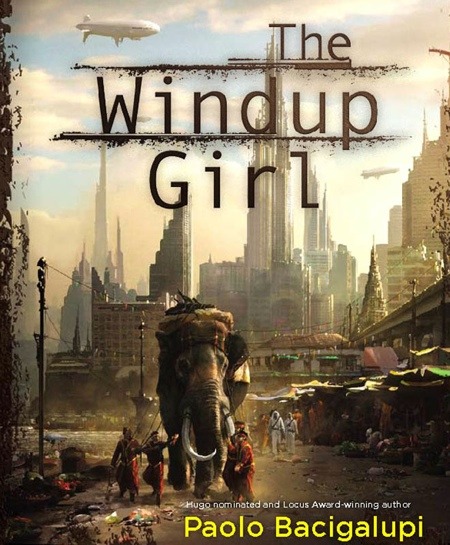
The Wind-Up Girl came highly recommended by my family, and of course the usual breathless praise from within the sci-fi community made it out to be nothing less than a Neuromancer for this modern age. Biopunk, a dystopian future made from only the freshest fears of the present. It partially delivers on this promise, but also fails in the ways modern books I’ve read recently tend to fail.
The premise is certainly the best part of the book. Some distance into the future, perhaps a hundred years or so, bioengineered crops and organisms have supplanted natural ones, giving rise to new plagues and food shortages — not to mention a rising sea due (I assume) to global warming. The result is the “Contraction,” a reversal of the “Expansion” era of our day. Fuel and power are precious and the universally acknowledged currency is calories. The story takes place in Krung Thep, AKA Bangkok, in Thailand, where the Thai have maintained independence by ingenuity, independence, and grit. And, as a new and disease-resistant fruit introduced at the outset suggests, a seedbank and skilled bioengineers.
Unfortunately, the book never really delivers on its promises. The landscape is foreign in a way, but also filled with the lazy analogues endemic to modern sci-fi. The “kink-springs,” for instance, are nothing more than batteries, no matter how named. The privations of the Contraction are no barrier to most of the characters, poverty and heat seeming to be the main difficulties — whenever a “rule” of the new world is inconvenient, it is discarded, and guns, cars, and other things that should be impossible in this new world regularly appear; one is not convinced of their rarity simply by the characters gasping at their appearance. And the story itself is easily abstractable from the world; the Environment Ministry (the “White Shirts”) and Trade Ministry could just as easily be Pepsico and Coca-Cola, or Boeing and Northrup Grumman, since the conflict is more or less political. That’s where the book fails: despite the well-conceived backdrop, very seldom in The Wind-Up Girl (an almost peripheral character, incidentally) does anything happen that couldn’t happen in any other book or world. In the end, the meat and potatoes are generic thriller, and the bioengineering and global cataclysm are simply sauce.
The writing is also spotty. Like so many modern books, whatever isn’t a labor of love (often the premise and a couple inspired characters or situations) is filler, and you can tell when Bacigalupi is writing something he doesn’t particularly care about. There are a few nice turns of phrase here and there, and the beginning hints at a fragmented timeline that is abandoned shortly. He lacks variety in his phraseology as well (towards the end of the book, during a firefight, I read the word “chatters” at least six or seven times in the space of a few pages), and the dialogue is totally undifferentiated. Every character speaks in the same voice, though their internal narration is better.
Bacigalupi has written several other stories that take place in this world, and it seems to me that his great accomplishment was painting the background, but he has yet to actually produce anything but sketches in the foreground. For world-building, he gets a gold star, but for storytelling, no credit. Other modern sci-fi I’ve read has the same prose shortcomings, but in the Virga trilogy (and even in Mainspring, an inferior book by far) the story was unique to the situation. Not so here.
As for the herd of mankind, he [i.e. the rational man] is too well acquainted with their conduct with their conduct both in private and in public; their infamous connections, the dissipation of their days and the revels of their nights. He cannot therefore be very ambitious of the praise or approbation of such capricious people, who are often at a loss to please themselves.

Anatomia Vegetal (Bibliodyssey)
Out of nothing, nothing can be brought;
And that which is, can ne’er be turned to naught.

Giorgio de Chirico, The Tower (Tarot)
Because when you think about it, this is how it really is.
 Const.: But she’s cold, my Friend, still cold as the Northern Star.
Lady Fancyfull, Lady Brute, and BellindaLady F.: Lord, how proud some would some poor Creatures be of such a Conquest? But I alas, don’t know how to receive as a favour, what I take to be so infinitely my due. But what shall I do to new mould him, Madamoiselle? for till then he’s my utter aversion.
Sir John BruteSir John: Best Wives! —the Woman’s well enough; she has no Vice that I know of, but she’s a Wife, and— damn a Wife; if I were married to a Hogshead of Claret, Matrimony would make me hate it.
School of Seven Bells – “Sempiternal/Amaranth”
Alpinisms
I had no idea this group, composed of former members of Secret Machines and On!Air!Library!, even existed. But their rhythmic, synth-washed, brand of whatever it is caught me by surprise at a coffee shop and I immediately picked up this album. This song isn’t the most representative, but it is perhaps the most striking – a metronomic, pitch-perfect opener (Sempiternal, presumably) followed by an extended mantra-like build-up and crash, and then a warm, prickly blanket of a coda. Unique and confident music-making. (Ghostly)
Or if we do applaud, honour and admire, quota pars, how small a part, in respect of the whole world, never so much as hears our names! how few take notice of us! how slender a tract, as scant as Alcibiades his land in a map! And yet every man must and will be immortal, as he hopes, and extend his fame to our antipodes, whenas half, no, not a quarter, of his own province or city neither knows nor hears of him: but say they did, what’s a city to a kingdom, a kingdom to Europe, Europe to the world, the world itself that must have an end, if compared to the least visible star in the firmament, eighteen times bigger than it? and then if those stars be infinite, and every star there be a sun, as some will, and, as this sun of ours, hath his planets about him, all inhabited, what proportion bear we to them, and where’s our glory?
Initium caecitas, progressus labor, exitus dolor, error omnia. [Blindness at the beginning, labor in the middle, grief at the end, error in all.]
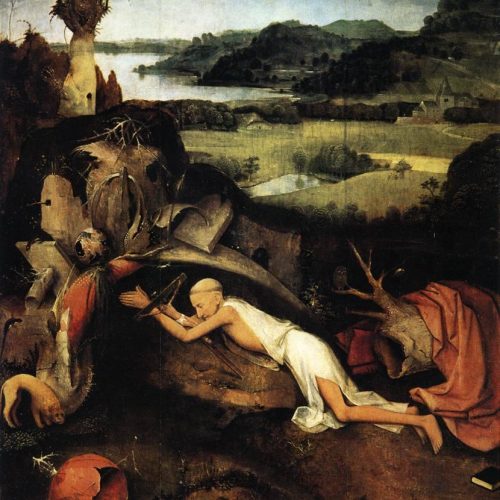

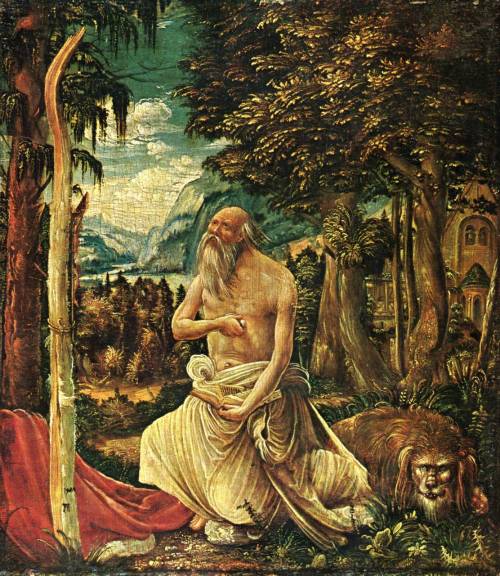
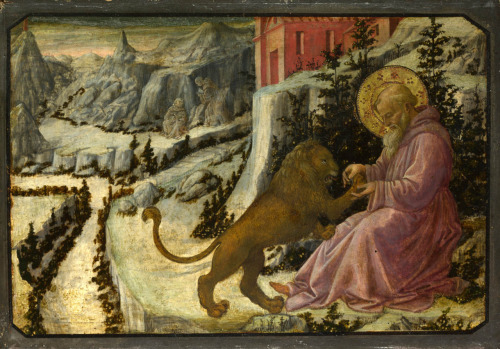
St. Jerome and the lion (Bosch, Benozzo Gozzoli, Albrecht Altdorfer, Filippo Lippi)
“Basically, we are outsourcing our brains to the cloud. The upside is that this frees a lot of gray matter for important pursuits like FarmVille and “Real Housewives.” But my inner worrywart wonders whether the new technologies overtaking us may be eroding characteristics that are essentially human: our ability to reflect, our pursuit of meaning, genuine empathy, a sense of community connected by something deeper than snark or political affinity.”
Dirty Three – “Lullabye For Christie”
Whatever You Love, You Are
Inevitably, whenever I run into a “what’s the saddest song in the world” discussion or article, my mind jumps immediately to “Lullabye For Christie.” Sure, there things like “Tears In Heaven”, Barber’s Adagio For Strings, much of A Silver Mt. Zion’s first album, and more recent stuff like The Antlers’ Hospice. But I always come back to this simple call and response, its inexorable, funereal procession and final unhinged shriek. Soundtrack to a burial at dawn.

Yearbook, 1943 – notice anything?