
The first among elegances is idleness.
Les Miserables
The first among elegances is idleness.
If it is the grandeur of the revolution to gaze steadily upon the dazzling ideal, and to fly to it through the lightning, with blood and fire in its talons, it is the beauty of progress to be without a stain; and there is between them the difference which separates the angel with the wings of a swan, from the angle with the wings of an eagle.
He was twice witty, first with his own wit, then with the wit which was attributed to him.
“Old books? The devil take them!” Goby said.
“Fresh every day must be my books and bread.”
Nature herself approves the Goby rule
And gives us every moment a fresh fool.
For what matter is it for us to know how high the Pleiades are, how far distant Perseus and Cassiopea from us, how deep the sea, etc.? We are neither wiser, nor modester, nor better, nor richer, nor stronger for the knowledge of it. What is astrology but vain elections, predictions? all magic, but a troublesome error, a pernicious foppery? physic, but intricate rules and prescriptions? philology, but vain criticisms? logic, needless sophisms? metaphysics themselves, but intricate subtleties and fruitless abstractions? alchemy, but a bundle of errors? To what end are such great tomes? why do we spend so many years in their studies? Much better to know nothing at all, as those barbarous Indians are wholly ignorant, than, as some of us, to be so sore vexed about unprofitable toys: stultus labor est ineptiatrum [it is foolish to labor at trifles], to build a house without pins, make a rope of sand, to what end? cui bono?
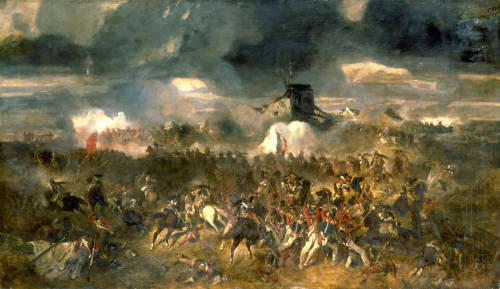
A passage from Les Misérables, with some minor aesthetic changes to form it into a shorter, more cohesive essay.
Napoleon’s army has just been scattered.
A few squares of the guard, immovable in the flow of the rout as rocks in running water, held out until night. Night approaching, and death also, they awaited this double shadow, and yielded unfaltering to its embrace. Each regiment, isolated from the others, and having no further communication with the army, which was broken in all directions, was dying alone. They had taken position, for this last struggle, some upon the heights of Rossomme, others in the plain of Mont Saint Jean. There, abandoned, conquered, terrible, these sombre squares suffered formidable martyrdom.
At dusk, towards nine o’clock in the evening, at the foot of the plateau of Mont Saint Jean, there remained but one. In this fatal valley, at the bottom of that slope which had been climbed by the cuirassiers, inundated now by the English masses, under the converging fire of the victorious artillery of the enemy, under a frightful storm of projectiles, this square fought on. It was commanded by an obscure officer whose name was Cambronne. At every discharge, the square grew less, but returned the fire. It replied to grapeshot with bullets, narrowing in its four walls continually. Afar off the fugitives, stopping for a moment out of breath, heard in the darkness this dismal thunder decreasing.
When this legion was reduced to a handful, when their flag was reduced to a shred, when their muskets, exhausted of ammunition, were reduced to nothing but clubs, when the pile of corpses was larger than the group of the living, there spread among the conquerors a sort of sacred terror about these sublime martyrs, and the English artillery, stopping to take breath, was silent. It was a kind of respite. These combatants had about them, as it were, a swarm of spectres, the outlines of men on horseback, the black profiles of the cannons, the white sky seen through the wheels and the gun-carriages; the colossal death’s head which heroes always see in the smoke of the battle was advancing upon them, and glaring at them. They could hear in the gloom of the twilight the loading of the pieces, the lighted matches like tigers’ eyes in the night made a circle about their heads; all the linstocks of the English batteries were approaching the guns when, touched by their heroism, holding the death-moment suspended over these men, an English general, Colville according to some, Maitland according to others, cried to them: “Brave Frenchmen, surrender!”
Cambronne answered: “Merde!”
Out of respect to the French reader, the finest word, perhaps, that a Frenchman ever uttered cannot be repeated to him1. We are prohibited from embalming a sublimity in history.
At our own risk and peril, we violate that prohibition.
Among these giants, then, there was one Titan — Cambronne.
To speak that word, and then to die, what could be more grand! For to accept death is to die, and it is not the fault of this man if, in the storm of grapeshot, he survived.
The man who won the battle of Waterloo is not Napoleon put to rout; nor Wellington giving way at four o’clock, desperate at five; not Blücher, who did not fight; the man who won the battle of Waterloo was Cambronne.
To fulminate such a word at the thunderbolt which kills you is victory.
To make this answer to disaster, to say this to destiny, to give this base for the future lion2, to fling down this reply at the rain of the previous night3, at the treacherous wall of Hougomont, at the sunken road of Ohain, at the delay of Grouchy, at the arrival of Blücher, to be ironical in the sepulchre, to act so as to remain upright after one shall have fallen, to drown in two syllables the European coalition, to offer to kings these privities already known to the Caesars, to make the last of words the first, by associating it with the glory of France, to close Waterloo insolently by a carnival, to complete Leonidas by Rabelais, to sum up this victory in a supreme word that cannot be pronounced, to lose the field, and to preserve history, after this carnage to have the laugh on his side, is immense.
It is an insult to the thunderbolt. That attains the grandeur of Æschylus.
This word of Cambronne’s gives the effect of a fracture. It is the breaking of a heart by scorn; it is an overplus of agony in explosion. Who conquered? Wellington? No. Without Blücher he would have been lost. Blücher? No. If Wellington had not commenced, Blücher could not have finished. This Cambronne, this passer at the last hour, this unknown soldier, this infinitesimal of war, realizes that here is a lie, a lie in catastrophe, doubly bitter; and at the moment when he is bursting with rage, he is offered this mockery — life? How can he restrain himself? They are there, all the kings of Europe, the fortunate generals, the thundering Joves, they have a hundred thousand victorious solders, and behind the hundred thousand, a million; their guns, with matches lighted, are agape; they have the Imperial Guard and the La Grande Armée under their heel; they have crushed Napoleon, and Cambronne only remains; there is none but this worm of the earth to protest. He will protest. Then he seeks for a word as one seeks for a sword. He froths at the mouth, and this froth is the word. Before this mean and monstrous victory, before this victory without victors, this desperate man straightens himself up, he suffers its enormity, but he establishes its nothingness; and he does more than spit upon it, and overwhelmed in numbers and material strength he finds in the soul an expression: excrement. We repeat it: to say that, to do that, to find that, is to be the conqueror.
To this word of Cambronne’s, the English voice replied: “Fire!” The batteries flamed, the hill trembled, from all those brazen throats went forth a final vomiting of grapeshot: a vast smoke, dusky white in the light of the rising moon, rolled out and when the smoke was dissipated, there was nothing left. That formidable remnant was annihilated; the guard was dead. The four walls of the living redoubt had fallen; and thus the French legions, grander than the Roman legions, expired at Mont Saint Jean on ground soaked in rain and blood, in the sombre wheat-fields, at the spot where now, at four o’clock in the morning, whistling, and gaily whipping up his horse, Joseph passes, and drives the mail from Nivelles.
The battle of Waterloo is an enigma. It is as obscure to those who won it as to him who lost it. To Napoleon it is a panic; Blücher sees it only in fire; Wellington comprehends nothing of it. Look at the reports. The bulletins are confused, the commentaries are foggy. The former stammer, the latter falter. Historians are blinded by the glare, and are groping about in that blindness.
In this event, bearing the impress of superhuman necessity, man’s part is nothing.
Does taking away Waterloo from Wellington and from Blücher detract anything from England and Germany? No. Neither illustrious England nor august Germany is in question in the problem of Waterloo. Thank heaven, nations are great aside from the dismal chances of the sword. Neither Germany, nor England, nor France, is held in a scabbard. At this day when Waterloo is only a clicking of sabres, Blücher, Germany has Goethe, and above Wellington, England has Byron. A vast uprising of ideas is peculiar to our century, and in this aurora England and Germany have a magnificent share. They are majestic because they think. The higher plane which they bring to civilisation is intrinsic to them; it comes from themselves, and not from an accident. The advancement which they have made in the nineteenth century does not spring from Waterloo. It is only barbarous nations who have a sudden growth after a victory. It is the fleeting vanity of the streamlet swelled by the storm. Civilised nations, especially in our times, are not exalted nor abased by the good or bad fortune of a captain. Their specific gravity in the human race results from something more than a combat. Their honour, thank God, their dignity, their light, their genius, are numbers that heroes and conquerors, those gamblers, can cast into the lottery of battles. Oftentimes a battle lost is progress attained. Less glory, more liberty. The drum is silent; reason speaks. It is the game at which he who loses, gains. Let us speak, then, coolly of Waterloo on both sides. Let us render unto Fortune the things that are Fortune’s and unto God the things that are God’s. What is Waterloo? A victory? No. A lottery.
A lottery won by Europe, paid by France.
It was not worth putting a lion there.
1. Some editions of the book were printed with Cambronne’s oath, then more serious a matter, censored.
2. An enormous monument on the site of the battle commemorating the victory and the injury of William II of the Netherlands, the Prince of Orange.
3. Rain, Hougomont, Ohain, Grouchy: Heavy rain the previous night had delayed the battle, and it is reasonably argued that if the battle had commenced an hour or two earlier, Napoleon would have been victorious. A savage ambush at the estate of Hougomont had severely damaged the French infantry there. The road of Ohain was a sunken road at the top of a hill which Napoleon’s cavalry was unaware of, into which hundreds of horses fell, spoiling their charge onto the plateau of Mont Saint Jean. Grouchy commanded some 33,000 men who, for a number of reasons, never arrived at the main battlefield.
We are unlearning certain things, and we do well, providing that while unlearning one thing we are learning another. No vacuum in the human heart! Certain forms are torn down, and it is well they should be, but on condition that they are followed by reconstructions.
In the meantime let us study the things which are no more. It is necessary to understand them, were it only to avoid them. The counterfeits of the past take assumed names, and are fond of calling themselves the future.
The people who govern the Brave New World may not be sane (in what may be called the absolute sense of the word); but they are not madmen, and their aim is not anarchy but social stability. It is in order to achieve stability that they carry out, by scientific means, the ultimate, personal, really revolutionary revolution.
Sape homo de vanae gloriae contemptu vanius gloriatur.
A man can be most boastful in expressing his contempt of fame.
Vivere nolunt, mori nesciunt.
They will not die; they dare not live.
Let us not carry flame where light alone will suffice.
‘I feel: therefore I exist.’ I feel bodies which are not myself: there are other existencies then. I call them matter. I feel them changing place. This gives me motion. Where there is an absence of matter, I call it void, or nothing, or immaterial space. On the basis of sensation, of matter and motion, we may erect the fabric of all the certainties we can have or need.
The light of history is pitiless; it has this strange and divine quality that, all luminous as it is, and precisely because it is luminous, it often casts a shadow just where we saw a radiance; of the same man it makes two different phantoms, and the one attacks and punishes the other, and the darkness of the despot struggles with the splendour of the captain. Hence results a truer measure in the final judgment of the nations. Babylon violated lessens Alexander; Rome enslaved lessens Caesar; massacred Jerusalem lessens Titus. Tyranny follows the tyrant. It is woe to a man to leave behind him a shadow which has his form.
There is no nonsense so arrant that it cannot be made the creed of the vast majority by adequate governmental action.
The discovery that man can be scientifically manipulated, and that governments can turn large masses this way or that as they choose, is one of the causes of our misfortunes. There is as much difference between a collection of mentally free citizens and a community molded by modern methods of propaganda as there is between a heap of raw materials and a battleship.
The Monuments that mightie Monarches reare,
Colosso’s statues, and Pyramids high,
In tract of time, doe moulder downe and weare,
Ne leave they any little memorie,
The Passenger may warned be to say,
They had their being here, another day.But wise wordes taught, in numbers sweet to runne,
Preserved by the living Muse for aie,
Shall still abide, when date of these is done,
Nor ever shall by Time be worne away:
Time, Tyrants, Envie, World assay thy worst,
Ere Homer die, thou shalt be fired first.
If a man be wealthy, no matter how he gets it, of what parentage, how qualified, how virtuously endowed or villainously inclined; let him be a bawd, a gripe, a usurer, a villain, a pagan, a barbarian, a wretch, Lucian’s tyrant, “on whom you may look with less security than on the sun”; so that he be rich (and liberal withal) he shall be honoured, admired, adored, reverenced, and highly magnified.
Syracuse started flat, with used-car dealers and junkyards. Then came stucco bars and appliance stores in converted clapboard houses. It was late Friday afternoon, with rush hour and week-end traffic starting to overlap. Parker pushed the Olds through the traffic, making the best time he could. South Salina Street. The stores got taller and older, the traffic heavier, till they were downtown, where all the streets were one way the wrong way.
"I hate this city,“ Parker said.
"It’s a city,” Handy replied. “They’re all like this.”
"I hate them all, then.
If a man have neither wife nor other to rule his household, know you how it is with the house? I know, and will tell you. If he be rich, and have plenty of grain, the sparrows and the moles eat their fill thereof. It is not set in order, but all so scattered abroad that the whole house is the fouler for it. If he have oil, it is all neglected and spilt; when the jars break and the oil is spilled, he casts a little earth on the spot, and all is done! In his bed, know you how he sleeps? He lies in a pit, with the sheets as they chance to have tumbled upon the bed; and they are never changed until they are torn. Even so in his dining-hall; here on the ground are melon-rinds, bones, and salad leaves, everything left lying on the ground without pretense of sweeping. He wipes the trenchers off; the dog licks them; so they are washed. His pipkins are all foul with grease: go and see how they stand! Know you how such a man lives? —even as a brute beast.
He who does not turn up the earth with the plough ought to write the parchment with his fingers.
He made no pretentions to botany, and knew nothing of groups or classification; he did not care in the least to decide between Tournefort and the natural method; he took no part, either for the utricles or against the cotyledons, or for Jussieu against Linnaeus. He did not study plants, he loved flowers. He had much respect for the learned, but still more for the ignorant; and, while he fulfilled his duty in both these respects, he watered his beds every summer evening with a tin watering-pot painted green.
For conduct which to clearer minds seems merely sane, was in those days to be performed only by rare vision and self-mastery.
Did I exist before my birth? No. Shall I, after my death? No. What am I? A little dust, aggregated by an organism. What have I to do on this earth! I have the choice to suffer or to enjoy. Where will suffering lead me? To nothing. But I shall have suffered. Where will enjoyment leave me? To nothing. But I shall have enjoyed. My choice is made. I must eat or be eaten, and I choose to eat. It is better to be the tooth than the grass.
One generation abandons the enterprises of another like stranded vessels.
Human thought has no limit. At its risk and peril, it analyses and dissects its own fascination. We could almost say that, by a sort of splendid reaction, it fascinates nature; the mysterious world which surrounds us returns what it receives; it is probable that the contemplators are contemplated.
Set not thy foot to make the blind to fall;
Nor wilfully offend thy weaker brother:
Nor wound the dead with thy tongue’s bitter gall,
Nor rejoice thou upon the fall of other.