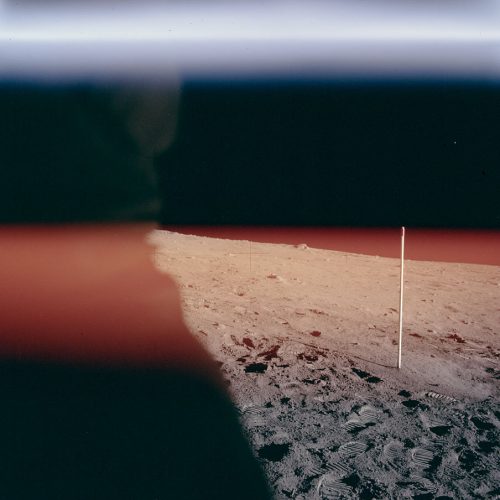
The Moon (RIP Neil)
The Moon (RIP Neil)
Let us not weary of repeating it: to think first of all the outcast and sorrowful multitudes, to solace them, to give them air, to enlighten them, to love them, to enlarge their horizon magnificently, to lavish upon them education in all its forms, to offer them the example of labor, never the example of idleness, to diminish the weight of the individual burden by intensifying the idea of the universal object, to limit poverty without limiting wealth, to create vast fields of public and popular activity, to have, like Briareus, a hundred hands to stretch out on all sides to the exhausted and the feeble, to employ the collective power in the great duty of opening workshops for all arms, schools for all aptitudes, and laboratories for all intelligences, to increase wages, to diminish suffering, to balance the ought and the have, that is to say, to proportion enjoyment to effort and gratification to need, in a word, to evolve from the social structure, for the benefit of those who suffer and those who are ignorant, more light and more comfort; this is, let sympathetic souls forget it not, the first of fraternal obligations; this is, let selfish hearts know it, the first of political necessities.
aeolipile: the first device to demonstrate the transformation of steam into rotary motion
hieratic: priestly or related to the script and art of certain ancient egyptian priests
scholomance: a legendary Transylvanian school of black magic (now in WoW)
pismire: pejorative name for an ant, on account of their formic acid smell
occurse: also occursion – a meeting, clash, or collision
imbonity: lack of goodness (mongrel Latin by Burton)
depilatory: capable of or serving to remove hair
sternutation: a sneeze, or the act of sneezing
immane: vast either in size or in cruelty
suffite: (Latin) to fumigate or perfume
sufflate: archaic alternative to inflate
refluent: ebbing or flowing back
Lights Dim / Gallery Six – “Sea of Tranquility”
Moon EP
This short ambient album was put out to commemorate the 43rd anniversary of the moon landing. It’s very reminiscent of the Fennesz/Sakamoto collaboration, Cendre, but a bit noisier. Only 21 hard copies were made (and sold), but you can pay what you like to get it at their Bandcamp page or download it for free at Archive.org.

“Through the Green Fuse” – electrified flowers by Robert Buelteman
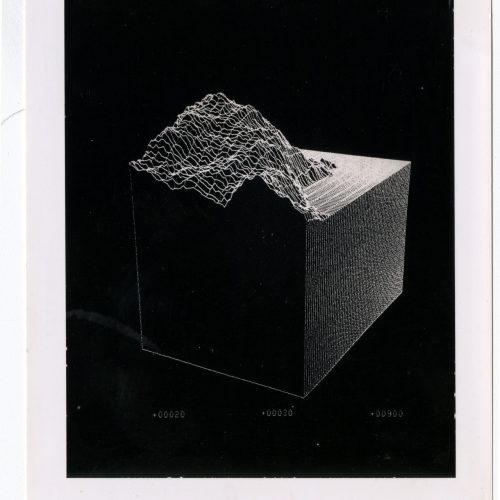
Benoit Mandelbrot
You know that, if you had a bent tube, one arm of which was the size of a pipe-stem, and the other big enough to hold the ocean, water would stand at the same height in one as in the other. Controversy equalizes fools and wise men the same way, — and the fools know it.
Lightning at 7207 frames per second (Tom Warner)
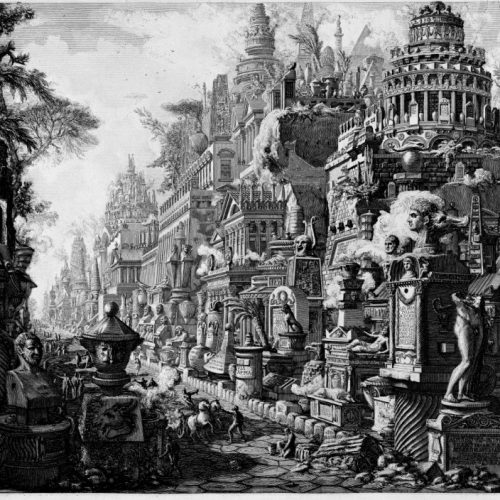
Appian Way – Piranesi (1756)
A truly enormous version that shows its many, many details can be found at Wikipedia.
Gregorio Allegri – “Miserere mei, Deus”
No day like today to reflect on the enormities of mankind, the number and scope of which have, incredibly, survived centuries of prayer. The piece itself (I have learned) was forbidden to be performed outside the Vatican or transcribed, on pain of excommunication. It was only after a 14-year-old Mozart memorized it during attendance and copied it out from memory that it escaped the confines of the Sistine Chapel; the Pope himself praised Mozart and the music was released for general performance.
Jack Rose – “Dusty Grass”
The Black Dirt Sessions
A bit like a minor-key “Rappahanock River Rag” at the beginning, but morphing into something more complex and urgent once it departs from its initial jangly theme. This EP is host to a number of excellent tracks, including an extended “Cross the North Fork” and a melancholy pair of tracks closing out the B side. Certainly worth a listen for fans of Jack Rose (RIP) and acoustic guitar in general. (insound)
Midway through Dracula, Stoker makes the following references in regards to extraordinary vigor and longevity:
 There are always mysteries in life. Why was it that Methuselah lived nine hundred years, and ‘Old Parr’ one hundred and sixty-nine, and yet that poor Lucy, with four men’s blood in her poor veins, could not live even one day? For, had she lived one more day, we could save her. Do you know all the mystery of life and death? Do you know the altogether of comparative anatomy and can say wherefore the qualities of brutes are in some men, and not in others? Can you tell me why, when other spiders die small and soon, that one great spider lived for centuries in the tower of the old Spanish church and grew and grew, till, on descending, he could drink the oil of all the church lamps?“

The biblical story doesn’t really warrant investigation, and Thomas Parr is established cryptoanthropology, but I was curious about the spider anecdote. A little research turned up the following in the "Literary and Scientific Intelligence” section of an 1821 number of the Edinburgh Magazine and Literary Miscellany:
Spiders.—The sexton of the church of St Eustace, at Paris, amazed to find frequently a particular lamp extinct early, and yet the oil consumed only, sat up several nights to perceive the cause. At length he discovered that a spider of surprising size came down the cord to drink the oil. A still more extraordinary instance of the same kind occurred during the year 1751, in the Cathedral of Milan. A vast spider was observed there, which fed on the oil of the lamps. M. Morland, of the Academy of Sciences, has described this spider, and furnished a drawing of it. It weighed four pounds, and was sent to the Emperor of Austria, and is now in the Imperial Museum at Vienna.“
It appears Dr. Van Helsing was exaggerating the length of the spider’s life somewhat, but the anecdote is at least based on what appear to be real events.
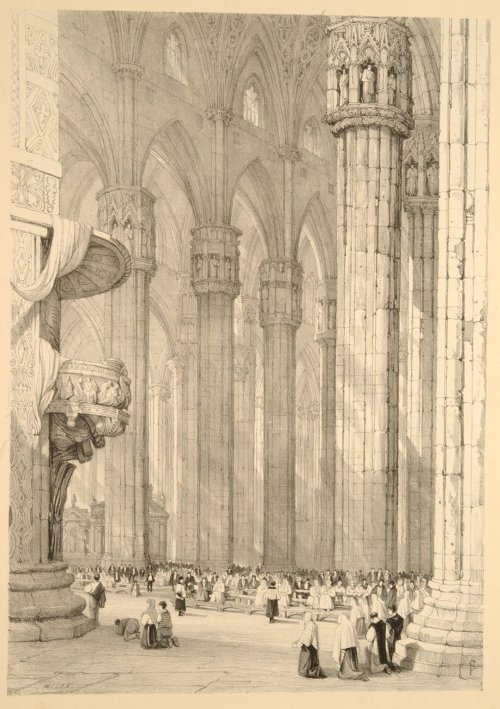
The drawing appears to be lost, unfortunately, though here is an image (Prout, 1839) of the cathedral in question, which appears capable of housing such an animal:
Mathematicians, like cows in the dark, all look alike to me.