Vocabulary: Kimmering Clachan Edition

Scots words and phrases from The Private Memoirs and Confessions of a Justified Sinner

braird: the early shoots of a crop of grain like wheat or barley
luckpenny: a sort of discount given to a buyer for luck
windelstrae: a stalk of dry grass
bicker: wooden drinking vessel
wynd: a narrow alley (i.e. wind)
aumuse: a cap worn by clergy
ayont: beside or adjacent to
bourock: a hovel or shelter
shakel-bane: wrist bone
clachan: a small village
Auld Simmie: the devil
spleuchan: pouch
kimmer: gossip
shan: grimace
mense: honor
rowth: plenty
corbie: black
chafts: jaws
maun: must
bairn: child

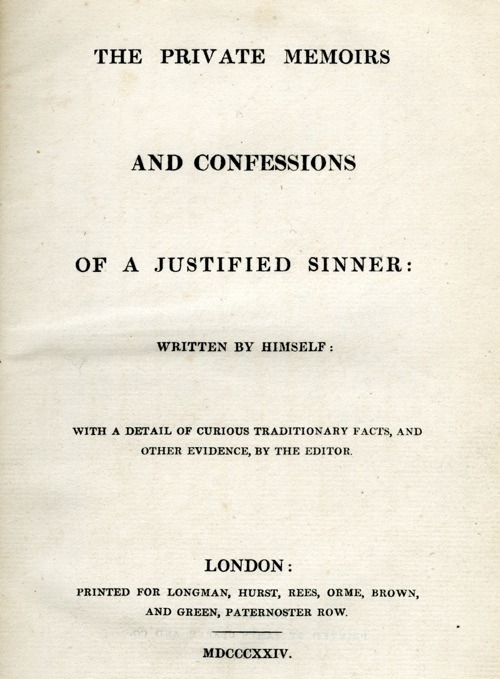
The Private Memoirs and Confessions of a Justified Sinner (James Hogg, 1824)

This interesting book was put in my hands by a good friend whose literary suggestions are sound without exception. It is not, as the title may suggest, a tell-all like Pepys’ diaries, or even, really, a private memoir at all. It’s a striking early example of nontraditional narrative structure, predating many other adventurous novels and reportedly inspiring Stevenson’s Jekyll & Hyde.

It’s remarkable for the transparency of its misdirection, which leaves the reader constantly unsure exactly what is true, and rarely pins anything down with certainty. So the reader, like the protagonist in fact ends up at one point in the novel, is suspended between several points of view and unable to make any definite conclusions. It begins with an “Editor’s narrative,” which describes a series of events at the turn of the 17th century involving two sons of a Scottish Laird, one of whom is disowned and becomes a religious zealot who torments and eventually kills the other for, apparently, no reason. Then follow the actual confessions, which are written by the religious brother, Robert, and seem to describe a descent into depravity and madness, accompanied and prompted by someone who may or may not be the devil. Last, there is a continuation of the editor’s narrative, which describes how the text was found.

As others have pointed out, this means the story is in a way told backwards; it would be far more logical to describe how the text was come across and its context, then present the text itself, then produce some criticism or notes to aid in its interpretation. Yet the point of the novel isn’t just to tell a story, though the story of how absolute certainty in an idea can, and in a way must, lead to the worst atrocities, is certainly interesting enough.

Read more
Did I exist before my birth? No. Shall I, after my death? No. What am I? A little dust, aggregated by an organism. What have I to do on this earth! I have the choice to suffer or to enjoy. Where will suffering lead me? To nothing. But I shall have suffered. Where will enjoyment leave me? To nothing. But I shall have enjoyed. My choice is made. I must eat or be eaten, and I choose to eat. It is better to be the tooth than the grass.

Les Miserables

One generation abandons the enterprises of another like stranded vessels.

Thoreau, Walden

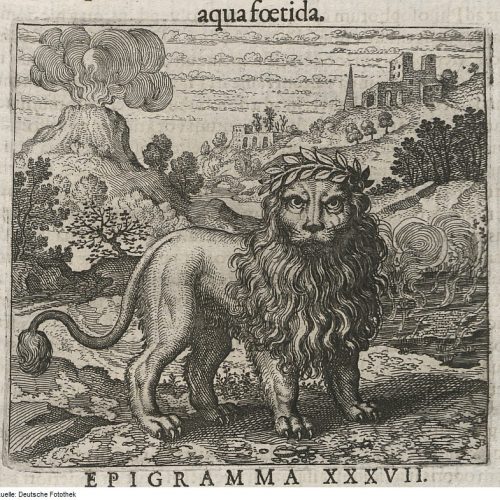
The Green Lion / Vitriol (Théodore de Bry, for Michael Maier’s Atalanta Fugiens, 1610)

Human thought has no limit. At its risk and peril, it analyses and dissects its own fascination. We could almost say that, by a sort of splendid reaction, it fascinates nature; the mysterious world which surrounds us returns what it receives; it is probable that the contemplators are contemplated.

Les Miserables

Set not thy foot to make the blind to fall;
  Nor wilfully offend thy weaker brother:
  Nor wound the dead with thy tongue’s bitter gall,
  Nor rejoice thou upon the fall of other.

Pybrac, Quatrains (17th c.)

tumblr_lw9iaqdRFO1qzv802

Plants And Animals – “Celebration”
La La Land

A slow-grow track from this versatile band, with one of those great sounds that keeps growing when you think they can’t add any more. Shades of Yeasayer. I’m hoping these guys have gotten popular over the last couple years but I have no way to be sure. (insound)

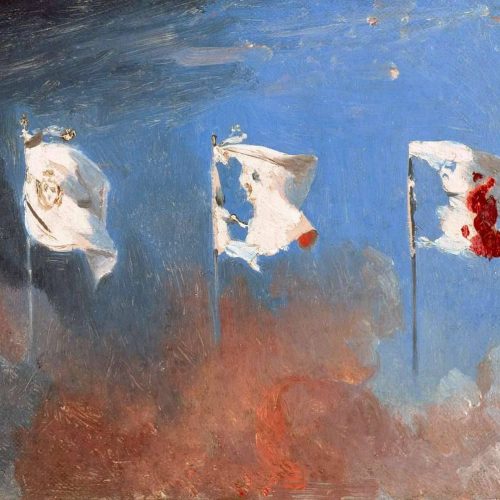
Léon Cogniet, Scenes of July 1830 (Les Trois Glorieuses)

Then he asked himself:

If he were the only one who had done wrong in the course of his fatal history? If, in the first place, it were not a grievous thing that he, a workman, should have been in want of work; that he, an industrious man, should have lacked bread. If, moreover, the fault having been committed and avowed, the punishment had not been savage and excessive. If there were not a greater abuse, on the part of the law, in the penalty, than there had been, on the part of the guilty, in the crime.

He questioned himself if human society could have the right alike to crush its members in the one case by its unreasonable carelessness, and in the other by its pitiless care; and to keep a poor man for ever between a lack and an excess, a lack of work, an excess of punishment.

If it were not outrageous that society should treat with such rigid precision those of its members who were most poorly endowed in the distribution of wealth that chance had made, and who where, therefore, most worthy of indulgence.

These questions asked and decided, he condemned society and sentenced it.

He sentenced it to his hatred.

Les Miserables

Vocabulary: Corporeal Grandiloquence Edition

perorate: to speak formally or at great length, or to conclude a speech in such a way
irredenta: a region allied by race or history to one country but ruled by another
naometer: apparently a title given in secret societies. Possibly a fabrication.
abnegation: self-denial, or the relinquishment of a right or property
anchylosis: the adhesion or growing together of bones in a joint
tendentious: showing a tendency, bias, or purpose
hylic: material or corporeal; pertaining to matter
atabeg: a Turkish high official, such as a vizier
spagyric: related to or resembling alchemy
sacerdotal: of or relating to priests
rachitic: suffering from rickets

The guillotine is the concretion of the law; it is called the Avenger: it is not neutral and does not permit you to remain neutral.

Victor Hugo, Les Miserables

Photogrammetry key chart for survey flyovers of the Mississippi Delta

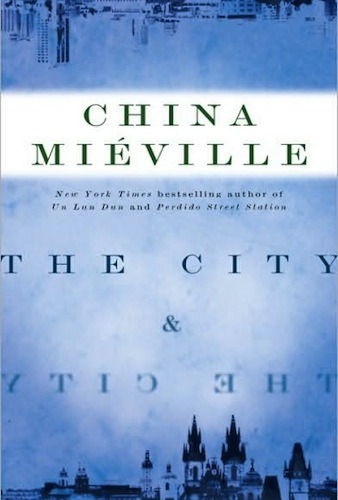
The City & The City (China Mieville, 2009)

This book has been recommended by many a shelf tag in book stores, and won a number of prizes last year, or maybe the year before. At any rate, like The Wind-Up Girl, it was showered with praise and I looked forward to being pleasantly surprised by one of the more critically-acclaimed sci-fi books out there. Alas, I have been deceived again, and while the book is certainly not bad, it’s rather disappointing and any reader must immediately acknowledge that the setting’s potential was squandered on a ho-hum story and an abrupt, unsatisfying ending.

Read more

So parents often err, many fond mothers especially, doat so much upon their children, like Aesop’s ape, till in the end they crush them to death, Corporum nutrices animarum novercaie, pampering up their bodies to the undoing of their souls: they will not let them be corrected or controlled, but still soothed up in everything they do, that in conclusion “they bring sorrow, shame, heaviness to their parents” (Eccles. xxx, 8, 9), “become wanton, stubborn, wilful, and disobedient”; rude, untaught, headstrong, incorrigible, and graceless. “They love them so foolishly,” saith Cardan, “that they rather seem to hate them, bringing them up not to virtue but injury, not to learning but to riot, not to sober life and conversation but to all pleasure and licentious behaviour.”

Anatomy of Melancholy

tumblr_lvjq5mdtDI1qzv802

Au Revoir Borealis – “Bella Ballerina”
Dark Enough For Stars

A wispy, melancholy instrumental from this shoegaze-y 2008 album. Would work well as background music for a day-in-the-life montage of a forlorn and lonely grocery bagger. (site)

Many mortal men came to see fair Psyche, the glory of her age, they did admire her, commend, desire her for her divine beauty, and gaze upon her; but as on a picture; none would marry her, quod indotata [because she had no dowry]; fair Psyche had no money. So they do by learning.

Anatomy of Melancholy (paraphrasing Apuleius)